
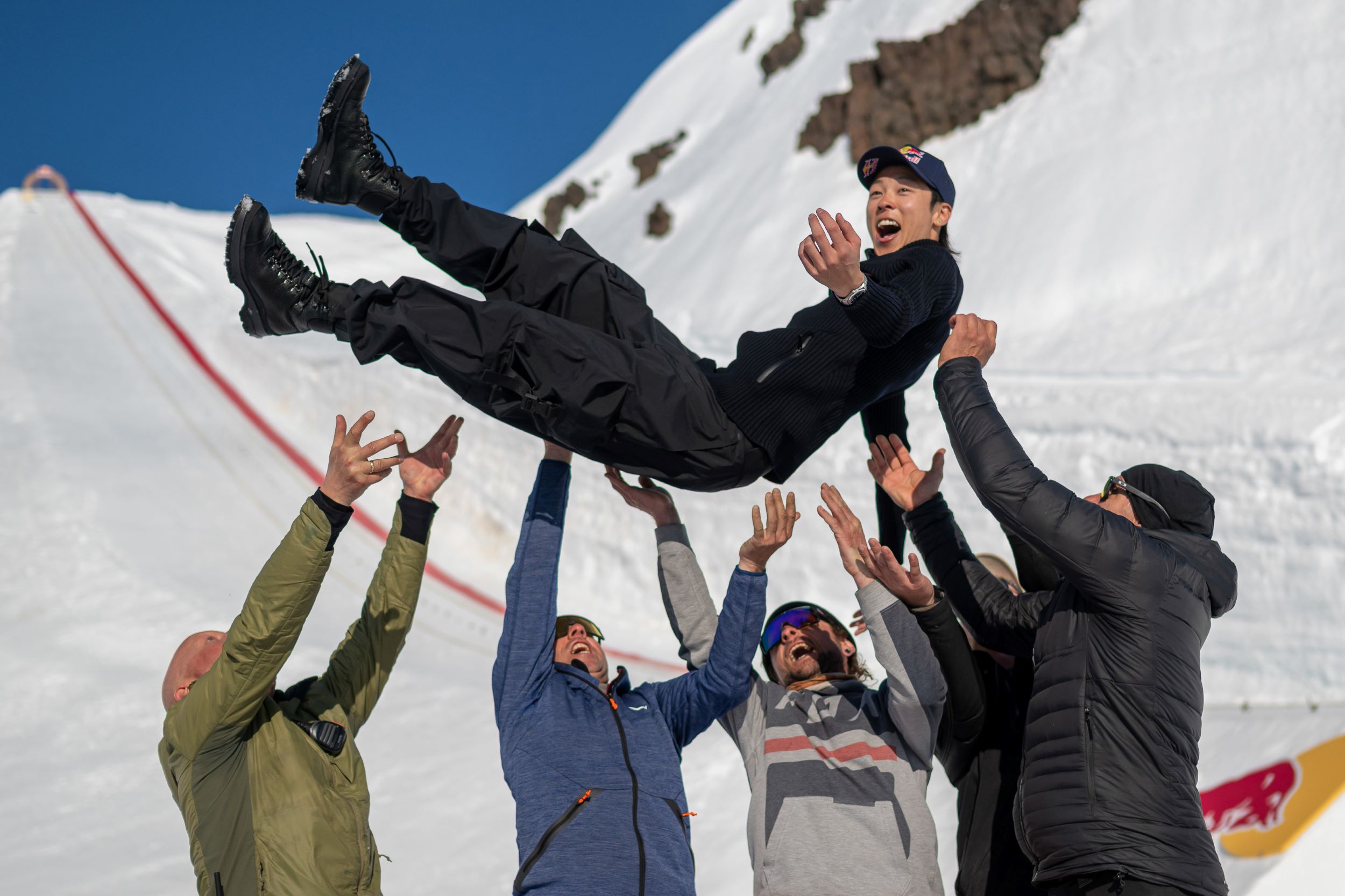
Members of the local ski club in Akureyri who assisted with the measurement of the jump itself along with our employee Steinþór Traustason from COWI in Akureyri, Bernhard Rupitsch from Red Bull, on either side of Ryoyu Kobayashi. © Photo by Red Bull.
The story behind the world's longest ski jump
24 May 2024
After an exhilarating collaboration with Red Bull, the world's longest ski jump was achieved on 24 April at the Hlíðarfjall mountain in Iceland. The moment was electrifying as Japanese ski jumper Ryoyu Kobayashi soared an astounding 291 metres – a height that rivals the Eiffel Tower.
Over the course of a year, Steinþór Traustason, a geographer at COWI in Iceland, worked tirelessly with Red Bull's team to prepare for the jump. The result: the world's largest ski jump ramp.
Despite the unpredictable Icelandic weather, everything went smoothly. Rumours claimed elves were part of it, but we won't go into that here.
After an extensive search for a suitable location for a ski jump of this magnitude, Red Bull staff made their final decision on the site. Iceland was chosen, specifically Akureyri, just north of the skiing area in Hlíðarfjall. The adventure officially started in April 2023 when Red Bull sought assistance from COWI in Iceland to construct the ski jump ramp. The goal was to break the previous world record of 253.5 metres, with COWI in Iceland initially tasked with obtaining geographical information about the proposed location.

Local community benefits
A tremendous amount of preparation followed, lasting an entire year. "COWI in Iceland analysed and compared the slope with several of the world's largest ski jump ramps, relying on our team's invaluable experience and connections. We were also involved in designing the ramp by performing check measurements of the structure and conducting quantity and length measurements of the jump itself. Additionally, we managed communication with the local community, connecting the Red Bull team with relevant parties involved in the project," explains Steinþór.
From the outset, the project was designed to leave the smallest possible environmental footprint during execution. No land was disturbed, and only natural snow was used for the ski ramp. All materials will continue to be utilised, benefiting the local ski club.
"One of the Red Bull employees came to Akureyri, and after flying the scenic route over the Northern Troll Peninsula, he visited our office here in Akureyri and asked to see maps and 3D models of the area at Hlíðarfjall. A few months later, they contacted us, requesting several profiles of the slope at Hlíðarfjall. Next, a Red Bull team came to Iceland, along with Ryoyu Kobayashi, to examine the conditions in Akureyri. They were very pleased with the site and impressed by the short communication paths between people."
Steinþór Traustason, Geographer at COWI in Iceland
From start to finish, the project had a very homely atmosphere, and locals from nearby areas immediately offered to assist with this worthy endeavour in various capacities.

48 Olympic pools
In collaboration with a university in Japan, Kobayashi's flight trajectory was calculated based on the conditions at Hlíðarfjall. The conclusion: he would need to reach at least 105 km/h to achieve a jump of up to 300 metres. It was clear from the beginning that the structure would not meet all the standards and conditions set by the International Ski Federation (FIS ). To accommodate such a ramp at Hlíðarfjall, considerably more snow was needed. Nonetheless, the unique landscape of the mountain allowed the ramp to be adapted accordingly.
Initially, the ramp was roughly designed to determine the amount of snow required for the project, which totalled 120,000 m3. For reference, that corresponds to 48 Olympic swimming pools. Impressive!

Snowstorms and elves
At the end of February this year, work began to push snow off the edge of Hlíðarfjall down into a small bowl-shaped terrain. Work continued around the clock on most days in March – that is when the elves came into action. Or did they? At the end of the month, efforts began to finalise the ramp, aiming for a jump the week after Easter. However, typical Icelandic weather disrupted the plans, and after three days of heavy storms, it was decided to wait for better weather conditions. "A week later, the team returned, and preparations resumed on Monday, 22 April. The days were long, but ultimately, the endeavour was successful," Steinþór concludes.

This was a tremendous feat of engineering, made possible by the immense work of our staff in close cooperation with Red Bull. This is the longest ski jump ever executed under optimal conditions. Perhaps this record will be broken in Akureyri in the near future?
Related news
-
17 September 2026 Global Finding the best route for Sweden’s new energy infrastructure
-
 30 August 2026
Global
COWI delivers strong growth and improves profitability
30 August 2026
Global
COWI delivers strong growth and improves profitability
-
 25 August 2026
Global
COWI appoints new Chief People Officer
25 August 2026
Global
COWI appoints new Chief People Officer
Headquarters
COWI A/S
Parallelvej 2
2800 Kongens Lyngby
Denmark
Shortcuts
Sustainability and governance
Terms of use