
Insight
The Next Phase for Offshore Wind: Digital Tools, Data-Driven Design and Hydrogen
Jan Behrendt Ibsø
On the surface, the ten massive wind turbines that make up the Jeonnam 1 Offshore Wind Farm (OWF) look like any other of its kind. But down below, at the ocean floor, there’s a story about an engineering problem and its solution that has a lot to say about where the offshore wind industry is heading.
Jeonnam 1 OWF is the first commercial offshore wind farm in South Korea and is nearing completion with an expected delivery of first power set for later this year. The project is a 51-49 joint venture between SK E&S and Copenhagen Infrastructure Partners (CIP).
Situated off the coast of Shinan County in Jeonnam Province, the finished wind farm will add 99 MW of clean energy generation to the Korean grid, effectively doubling the country’s current installed capacity of100 MW GW. The wind farm is expected to produce green electricity equivalent to the consumption of approximately 60,000 households in South Korea.
Overcoming seabed mobility and other challenges
The project encountered various technical challenges throughout the design phase. Most notably the engineers had to deal with significant seabed mobility – a challenging phenomenon where the entire seabed in the area is being exposed to either erosion or sedimentation over time.
A considerable amount of engineering effort was dedicated to accurately incorporate this phenomenon into the design process. The approach resulted in a foundation design that balances the necessary conservatism with optimal efficiency.
The site's water depth ranges from 5 to 20 meters with the selected solution of steel monopile foundations featuring an 8-meter diameter. Scour protection measures around monopiles are essential at the site, yet they cannot counteract the potential global seabed lowering occurring beyond the protected area.
Due to the combination of seabed mobility and environmental conditions, including shallow water depths at some of the locations, identifying a uniform design for scour protection proved challenging.
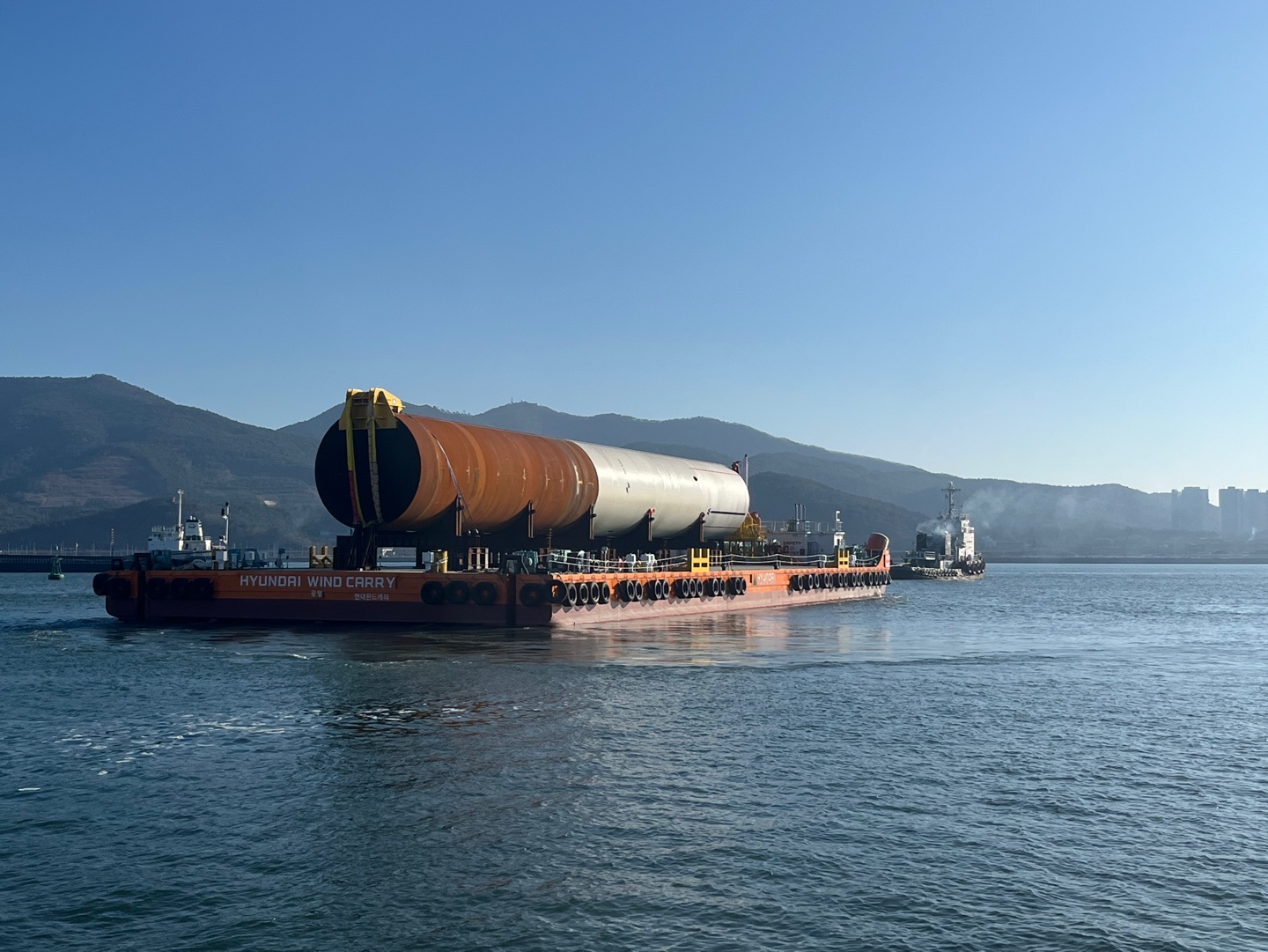
This situation required conducting physical model tests to develop tailored scour protection strategies that could effectively address these unique conditions. A joint effort between the project owners, the Transport and Installation Contractor, COWI, and Deltares, a world-leading institute in The Netherlands, made it possible to find the optimal scour protection solution at Jeonnam 1 OWF, accounting for the challenging conditions at the positions investigated.
The process shows how digital tools can help when an offshore wind project is challenged by a complex environment. This is key for further scaling up the industry, since the power of digital models and big data sets this way can help realise offshore wind farms on sites that previously would have been deemed too expensive or risky to utilise.

Using digital platforms to optimise design of monopile foundations for offshore wind turbines
At COWI we have come to rely on a number of digital platforms whenever we help design the world’s large offshore wind farms. We develop some of the software ourselves and one of the more recent tools to be added to our kit is called COWIND Digital Toolchain. It is specifically designed for optimising the design of monopile foundations for offshore wind turbines.
This platform takes into account thousands of parameters to determine optimised and consistent designs for each foundation. It operates in the cloud, allowing for scalability and adaptability to changing design requirements. COWIND Digital Toolchain is flexible and can be customised to meet project-specific needs while ensuring compliance with ISO 9001 for traceability and standardisation.
Another example of a useful digital tool is COPILOD, which allows for the direct generation of design drawings and reports. It significantly speeds up the production of foundation designs, reducing costs and resources by up to 80%. Further we deploy COSPIN and COWAL as support systems. COSPIN is used for geotechnical design checks, while COWAL generates wave loads. These systems automate processes and improve efficiency in the design phase.

Streamlining design processes with digital tools
Software platforms and tools like these have become indispensable in order to streamline the design process, reduce costs, and improve efficiency in offshore wind farm projects and we will undoubtedly see the industry move towards a more digitalised and data powered approach to design in the years to come.
For both the Jeonnam 1 project and other recent offshore wind farm projects the software has been essential to standardising the foundation design across the several foundation units found within any offshore wind farm. This standardisation process is saving costs, and it also simplifies the manufacturing process, and the installation phase for the offshore wind farm project.
Jeonnam 1 OWF’s foundation solution also comprises innovative installation solutions. The embedded part of the foundation being either composed of a monopile (MP) driven to target depth with an impact hammer or composed of several structural components: monopile (MP), insert pile (IP) and grout annulus, to form a rock socket. COWI's extensive experience with drilled monopile foundations played a crucial role in this strategic decision, ensuring the foundation's adaptability and resilience to the site's conditions.
With achieved project certification, Jeonnam 1 OWF is not only a significant benchmark for South Korea but also serves as a reference for future offshore wind projects by SK E&S and CIP/COP, both in South Korea and internationally.
Jan Behrendt Ibsø, Group Senior Vice President Renewables and PtX
Jeonnam II and III offshore wind farm projects in pipeline
Jeonnam II and III offshore wind farm projects are already in the pipeline and early design works have been initialised. Together with Jeonnam 1 these projects will bring the total added offshore wind power capacity to app. 1 GW – a significant contribution to South Korea’s politically set goal of reaching 14.3 GW of installed capacity.
Many offshore wind farm projects are currently in the planning and development phase in South Korea. However, like in many other countries, the electrical grid constraints are very significant in South Korea. Hence some of the green power from the planned offshore wind farms will have to be converted into e.g. hydrogen for the use for the heavy steel manufacturing industries in the country.

Offshore Wind and Hydrogen
Combining offshore wind with hydrogen production is receiving increased attention and interest across the world due to some key factors influencing the build out of offshore wind and green fuels.
In Europe, the politically set target of establishing more than 300 GW of offshore wind capacity towards 2050, just in the North Sea, causes an immediate problem: The grid onshore will not be able to handle this load coming in from the sea. At the same time most countries will face constraints related to electrical transmission which will make it difficult for such an amount of green energy to reach its end user.
Offshore wind farms when located more than approximately 70-80 km from shore will also need expensive High Voltage Direct Current (HVDC) equipment offshore, including very expensive converters and transformers and costly electrical transmission offshore cables.
To minimise the energy losses, it is key to place the consumption or the conversion of energy in the proximity of the offshore wind farm.
To transport the energy in the form of hydrogen, which is needed as the energy carrier for e.g., for the green transition in the chemical and steel manufacturing industries, is appr. 1/5 of the cost of transporting the energy as electrical power.
If offshore wind and electrolysis is combined offshore, it is possible to have a higher utilisation of the electrolysis plant and hence have more operational full load hours of hydrogen production.
Using a combination of electrical transmission and hydrogen as energy carriers also provides a flexibility as to use hydrogen when e.g., the electricity prices are low or negative and electrical transmission when the demand for electricity is higher and the electricity prices are higher.
Making these considerations are key for the budding Korean offshore wind industry and really for all markets with huge plans for scaling up their capacity. At this pivotal moment in the scale up of offshore wind, it is important to harness the energy of the wind in ways that both makes financial sense and not least brings the most value to consumers.”

Comparison across energy hub concepts
Together with renewables consultancy Brinckmann, COWI has analysed different cases and scenarios of offshore wind combined with hydrogen production. First case shown on the left on the below Figure is where we have a fully system integrated H2 energy hub offshore with a hydrogen pipeline (48") to shore.
Another case shown to the right is where we have a traditional pure electricity hub offshore with an electrical transmission to shore and H2 production onshore behind the meter (direct transmission line to the electrolysis plant).
The cases are all for 10 GW offshore wind farms located 90 km from shore in the North Sea and at app. 30m water depth. The energy hub can be a jacket platform or an artificial island.
The difference in Levelised Cost of Hydrogen (LCOH) is a 16% lower LCOH for a system integrated H2 energy hub offshore.
The middle case in the Figure below is for a limited (1 GW) electrical transmission connection to shore and it shows a similar result as fully system integrated H2 energy hub offshore.

Seven tips for offshore wind developers: Focus on reliability, flexibility & innovation
Some of the possible solutions that focus on reliability, flexibility, and innovation for an offshore wind farm (OWF) project are the following:
- Feasibility Studies: Conduct thorough feasibility studies to identify technically and financially feasible locations for OWFs that have the least possible impact on the environment and society.
- Conceptual Design: Select optimal foundations and turbine locations through a comprehensive conceptual design process. This establishes a basis for the financial assessment of the OWF.
- Wind Resources Analysis: Utilise high-quality analysis, measurements, wind resource studies, and site-specific wind data input to ensure accurate assessment of wind resources and maximise energy production.
- Metocean Studies: Perform site-specific meteorological and oceanographic studies, taking into account anticipated climate change effects, wave and hydrodynamic modeling, and statistical analysis to ensure design accuracy.
- Aeroelastic Loads Analysis: Determine wind loads and conduct structural response analysis to assess the aeroelastic behavior of the turbines, ensuring their structural integrity and reliability.
- Geoscience Surveys: Conduct comprehensive geological studies, geophysical surveys, and geotechnical investigations to facilitate the design and selection of appropriate foundation types such as jacket piled foundations, monopiles, anchored foundations, gravity-based foundations, and suction caissons.
- Scour Assessment and Protection: Assess and design scour protection measures to mitigate the potential impact of seabed erosion on the OWF structures.
This article was originally published in Energy Global on the 7 June, 2024
Related Insights
-
 Turning up the heat: new potential for district heating across Europe
Renewable energy
Turning up the heat: new potential for district heating across Europe
Renewable energy
-
 Microgrids: Local power grids offer the vitamins future energy needs
Renewable energy
Microgrids: Local power grids offer the vitamins future energy needs
Renewable energy
-
 Prioritising cost, security and growth in global energy
Renewable energy
Prioritising cost, security and growth in global energy
Renewable energy
Headquarters
COWI A/S
Parallelvej 2
2800 Kongens Lyngby
Denmark
Shortcuts
Sustainability and governance
Terms of use