
Wind and heat – how to build comfier cities
19 November 2024
As cities grow, we build denser areas and taller buildings, which leads to cities becoming excessively hot and windy. “Whether it's Gothenburg or Manhattan, in order to achieve good urban planning, we need to optimise for both heat and wind conditions and air quality," says Marie Haeger-Eugensson, Head of Research and Development at COWI in Sweden.
While temperatures rise due to climate change, our cities become more compact. Heat islands emerge – areas where temperatures are higher compared to areas outside the cities – and contribute to increased health risks, especially for the elderly and young children.
"By mapping heat conditions and air quality, we can help create detailed plans that take these factors into account. In practice, this often involves creating shaded areas, which often means more vegetation and green spaces, which we know create cooler urban climates and often better air quality," says Marie Haeger-Eugensson, who is Head of Research and Development at COWI in Sweden and also conducts research in heat and air environments.

"Whether it's Gothenburg or Manhattan, in order to achieve good urban planning, we need to optimise for both heat and wind conditions and air quality"
Marie Haeger-Eugensson., Head of Research and Development at COWI in Sweden
Taller buildings – windier cities
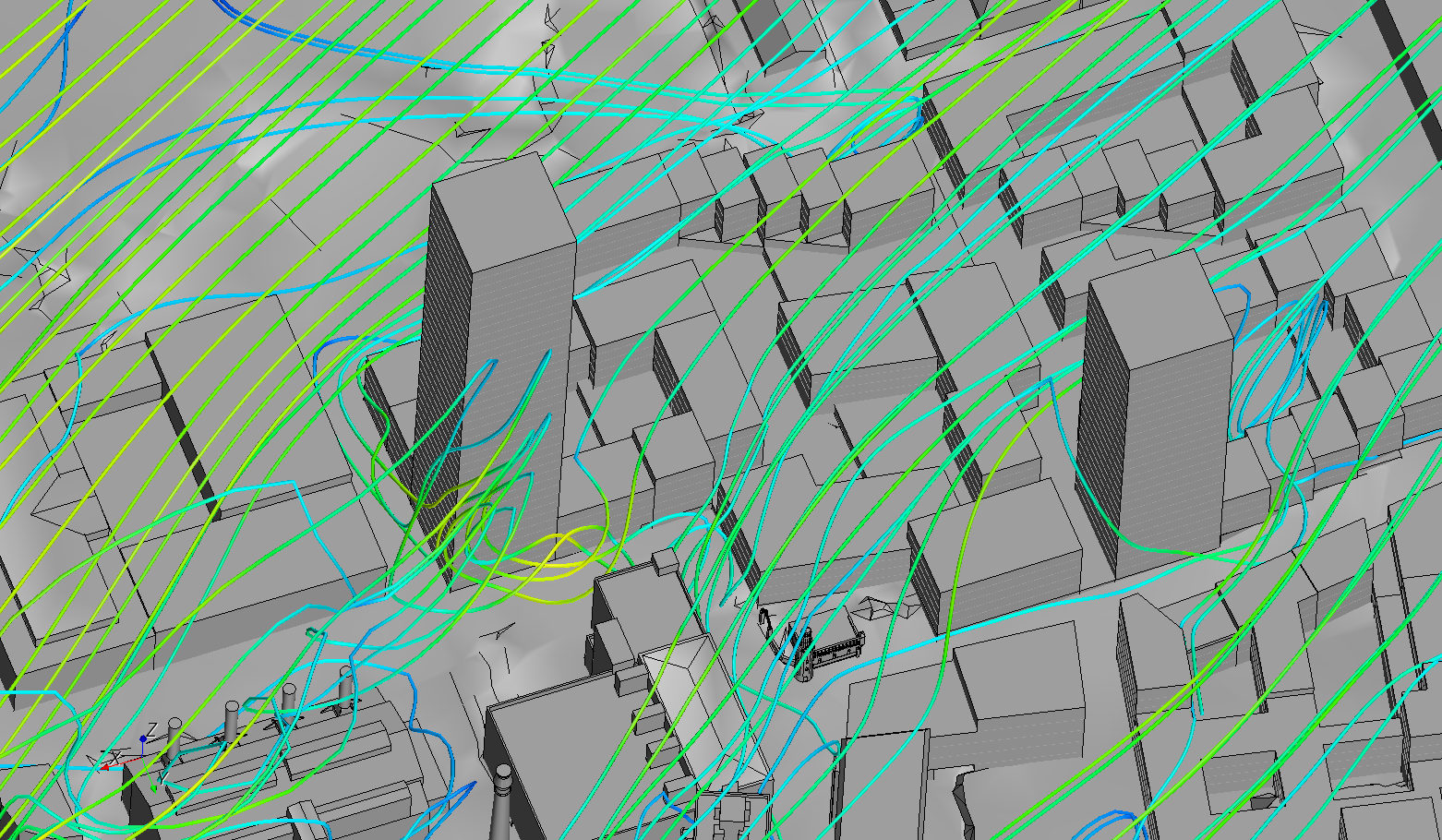
Wind and heat go hand in hand in the local climate of cities. Wind can be cooling, but when it becomes too gusty on streets and squares, it can be disruptive and even dangerous. Furthermore, wind conditions depend on how we plan our cities. In Gothenburg, several tall buildings have been constructed in recent years, such as Karlatornet and Hotellet Draken. Building vertically poses certain problems because the buildings can create efficient ‘wind channels’ that direct strong winds down to the street level or through narrow streets and passages, increasing the wind speed.
Sanne Poulin works with wind simulation at COWI, a long-time favourite tool in bridge construction. But now there is increasing interest from urban planners in Nordic countries.
"They are becoming more aware that wind must be considered in planning – and at an early stage, not least. That way, wind simulations can identify problems, and we can integrate improvements into the plan. It is rarely effective to solve a problem afterwards," says Sanne Poulin.
An example of a late-stage solution is to install screens on building facades that break the wind flow.
"Screens on facades are not always a particularly effective method. Instead, tall buildings can have one or two broader floors at the bottom and be moved away from street corners. This is more effective at stopping winds," she says.
Another method is to create space for trees and plants near buildings in the early stages, as they can disrupt the path of the winds and create shade.
"One measure to improve densely built areas is to use vegetation, for example, in urban street spaces. This provides both shade and breaks up the wind, but if it isn’t planned properly, it can worsen air quality. When it comes to heat, it is also important to have cooler areas, such as parks, within walking distance to create 'cool places'," says Marie Haeger-Eugensson.

"Simulations can identify problems, and we can integrate improvements into the plan. It is rarely effective to solve a problem afterwards"
Sanne Poulin, Wind comfort specialist at COWI
Simulations guide the way
To limit wind speed, it is important to take a comprehensive approach to the planned area. If the wind speed at a location is too high, this calls for effective solutions.
"It is always a good idea to first conduct an overall assessment to identify problem areas in terms of both wind speed and heat in order to propose the most effective measures," says Marie Haeger-Eugensson.
In areas under construction, wind simulations can be used to assess whether different areas within a site will be pleasant to stay in, and how often wind speeds will exceed a defined threshold. The criteria vary, but around 5 metres per second is often considered a threshold for what is perceived as comfortable by people when they are in an open area such as a square.
The purpose of Sanne Poulin's work is to create pleasant and safe streets and ground-level spaces. COWI's project in Carlsberg Byen in Copenhagen is an example of this. Here, an area with mixed buildings was planned, including some tall buildings, some of which were located on street corners.
"Originally, the facades were completely horizontal, which indeed contributed to high wind speeds. But our work with wind simulations was well-received, and the facades were redesigned to have a broader base, and the higher floors were set back further from the street. These are examples of solutions that contribute to more pleasant wind conditions," says Sanne Poulin.
Related news
-
17 September 2026 Global Finding the best route for Sweden’s new energy infrastructure
-
 30 August 2026
Global
COWI delivers strong growth and improves profitability
30 August 2026
Global
COWI delivers strong growth and improves profitability
-
 25 August 2026
Global
COWI appoints new Chief People Officer
25 August 2026
Global
COWI appoints new Chief People Officer
Headquarters
COWI A/S
Parallelvej 2
2800 Kongens Lyngby
Denmark
Shortcuts
Sustainability and governance
Terms of use