Skygard data centre, Norway
Green gigabytes – the data centre of the future in the heart of Oslo

About
Challenge
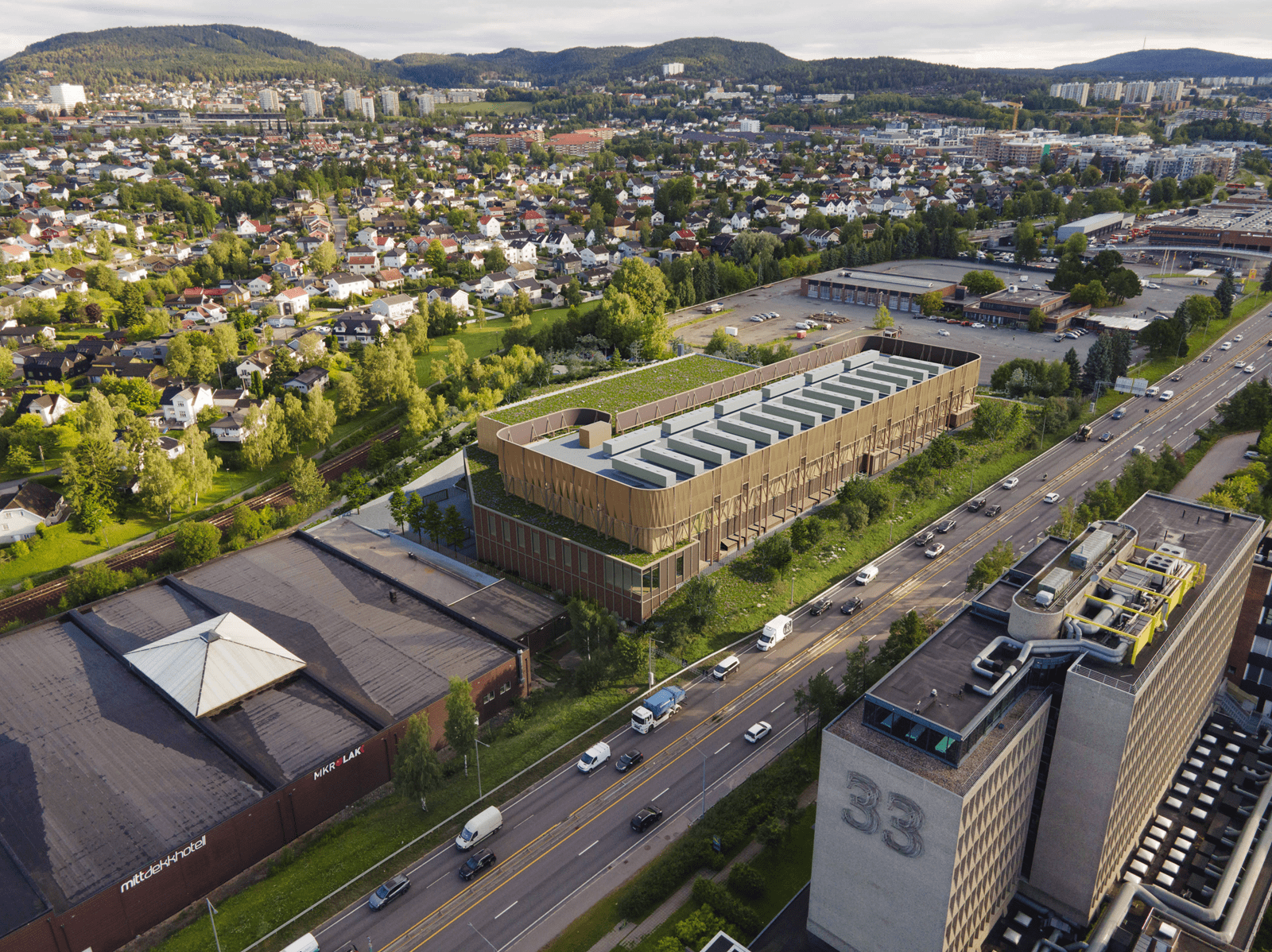
Establishing a modern, low-impact, high-security data centre with colocation facilities for multiple tenants on a former industrial site in Central Oslo. The plot is situated between a heavily trafficked highway on one side and light rail tracks on the other.
Solution
Creating a state-of-the-art data centre that doubles as a green space in the heart of the Norwegian capital.
Value
The Skygard data centre is powered by 100% renewable, Norwegian hydropower and integrates its surplus energy into the local district heating system, supplying 12,000 Oslo homes. This makes Skygard far more sustainable than most other data centres.
Specifications
Capacity
A 50,000 m² data centre
Location
Oslo
Period
2024–2025
Country
Norway
Partners
Skygard, A-lab
Services
Site selection and due diligence; knowledge of local conditions and relations; design; underground supply; MEP engineering; civil and structural work; architecture; landscape architecture; infrastructure; renewable energy; and use of excess heat.
National security, data safety and environmental responsibility
For Skygard, it was essential to create a data centre that could both address national security, data safety and sustainability, and bolster Norway's position in artificial intelligence (AI).
In addition, the Skygard data centre is among the most energy-efficient data centres in Norway. It uses renewable energy sources, and surplus energy from its servers is integrated into the city's district heating system.

With the investment in Skygard and other data centres, we are providing Norway with a much-needed data centre capacity that prioritises national security, data safety and sustainability. The current geopolitical situation has made the need for secure solutions more important, but there is also an urgent need to improve the environmental footprint of data centres. With Skygard, we address all these issues and set a new standard for the future.
Elise Lindeberg , CEO, Skygard
From brown to green spaces
Skygard took an innovative approach by transforming an industrial brownfield area into a lush green public space for the citizens of the Norwegian capital.
By choosing this site, the data centre not only had minimal impact on existing biodiversity; indeed, it contributed to urban greening.

A data centre designed for the future
As demand for digital infrastructure continues to grow, Skygard set out to develop a modern data centre that combines operational performance with a strong sustainability profile. Located in Hovinbyen, one of Oslo's largest urban development areas, the facility was designed to meet strict technical and regulatory requirements while supporting a more resource-efficient approach to data centre operations.
Compared with older facilities, modern data centres can significantly reduce energy consumption through more efficient cooling, power and operational systems. At Skygard, the opportunity to recover surplus heat for district heating further strengthens the project's contribution to Oslo's sustainable urban development.
Overcoming urban constraints
The location presented a unique challenge. Positioned between a city street and a light rail line, the site offered limited space and demanded careful coordination throughout planning, design and construction.
Balancing technical requirements, urban integration and operational resilience required solutions that could accommodate both the demands of critical digital infrastructure and the realities of a dense city environment. The result is a future-ready facility that supports Norway's growing digital economy while fitting seamlessly into the evolving fabric of Hovinbyen.
In a time when data centres are facing increased scrutiny due to energy consumption and land use, Skygard has been a visionary project that pointed the way to the future way of creating data centres. At COWI, we are excited to have formed an integral part of Skygard's project because it allowed us to apply our capacities to fulfil the wishes and needs of our client.
Rasmus Brandt, Market Director, COWI.
Related projects
-

The Valley Campus, Denmark
Offices, production and social hub for Everllence
-

INCUBA Next, Denmark
Where tech innovation grows in a sustainable setting
-

Zealand University Hospital Køge, Denmark
Bringing the past into the future
Headquarters
COWI A/S
Parallelvej 2
2800 Kongens Lyngby
Denmark
Shortcuts
Sustainability and governance
Terms of use